 blog
blog
Best Used Cars for Small Families: 2026 Buyer's Guide
Table of Contents
- What Makes a Used Car Right for a Small Family
- Top Used Cars for Small Families: Comparison Table
- Best Used SUVs for Small Families
- Best Used Sedans for Small Families
- Used Car Inspection Checklist for Family Vehicles
- How to Finance a Used Car With Challenged Credit
- Total Cost of Ownership: What Families Actually Pay
- Conclusion
- Frequently Asked Questions
Last Updated: September 28, 2026
What Makes a Used Car Right for a Small Family
Finding the best used cars for small families comes down to three things: child seat installation, cargo room behind the second row, and predictable long-term costs. This guide from AutoMatch USA INC walks through each.
Car Seat Installation Compatibility
Car seat installation compatibility measures how securely and easily a child restraint anchors to a vehicle's seat, using the lower LATCH system or the seat belt. It is the most overlooked spec in family car shopping.
Cargo Space and Trunk Capacity
Trunk space matters more than horsepower once a stroller enters the picture. Look for at least 15 cubic feet behind the second row in a sedan, or 25 in a compact SUV.
Top Used Cars for Small Families: Comparison Table
Most family-car roundups rank vehicles by price or crash-test stars, missing the two things that decide whether a used car works for a small family: whether a rear-facing car seat fits without crushing the front passenger, and what the vehicle really costs over five years. The table below scores popular used family vehicles on those dimensions.
| Model (used) | Body Style | Rear Cargo (cu ft, seats up) | Rear-Facing Fit Behind 5'10" Driver | Typical 5-Yr TCO Band | Notes |
|---|---|---|---|---|---|
| Honda CR-V (2017-2021) | Compact SUV | ~39 | Fits with room to spare | Moderate | Wide rear bench, easy LATCH access |
| Toyota RAV4 (2016-2021) | Compact SUV | ~37 | Fits; front seat moves up slightly | Low-Moderate | Strong resale, hybrid option |
| Subaru Forester (2017-2021) | Compact SUV | ~33 | Fits; tall roofline aids loading | Moderate | Standard AWD, big door openings |
| Mazda CX-5 (2017-2021) | Compact SUV | ~30 | Tight; test before buying | Moderate | Best to drive, smallest back seat here |
| Toyota Camry (2018-2022) | Midsize sedan | ~15 | Fits; watch short rear cushion | Low | Excellent fuel economy, cheap insurance |
| Honda Accord (2018-2022) | Midsize sedan | ~17 | Fits; generous rear legroom | Low | Huge back seat for the class |
| Hyundai Elantra (2017-2020) | Compact sedan | ~14 | Tight; center LATCH helps | Low | Budget pick, verify service history |
| Toyota Prius (2016-2022) | Hybrid hatch | ~27 | Fits; low load height | Low | Best fuel economy on this list |
How to Read This Table
Cargo figures are behind the second row with seats up, the number that matters when a stroller is in the trunk and kids are in the back. The TCO band reflects fuel, insurance, maintenance, and expected repairs over five years, not the purchase price. A cheap SUV with a thirsty V6 can cost more per month than a pricier sedan with strong resale.
Car Seat Fit: The Spec Nobody Publishes
Rear-facing seats need roughly 30-32 inches of clearance from the seatback to the front seatback in most convertible and infant models. Compact SUVs and midsize sedans usually clear this; subcompact sedans and coupes often don't. Three checks:
- LATCH anchor location. Outboard anchors are easier to reach than center-only setups. Some vehicles hide anchors behind stiff seat cushions.
- Seat cushion angle. Deeply bucketed rear seats tilt rear-facing bases, forcing you to over-tighten the tether to level the seat.
- Tether anchor access. Top tether anchors on the rear of the seatback or cargo floor are easier than anchors buried under headrests.
NHTSA car seat installation guidance
Why This Beats a Price-Only Ranking
A $9,000 compact SUV with a clean history and easy car-seat access can beat a $14,000 model with a tight back seat and unknown maintenance. Rank by fit and five-year cost, then negotiate on price.
Best Used SUVs for Small Families
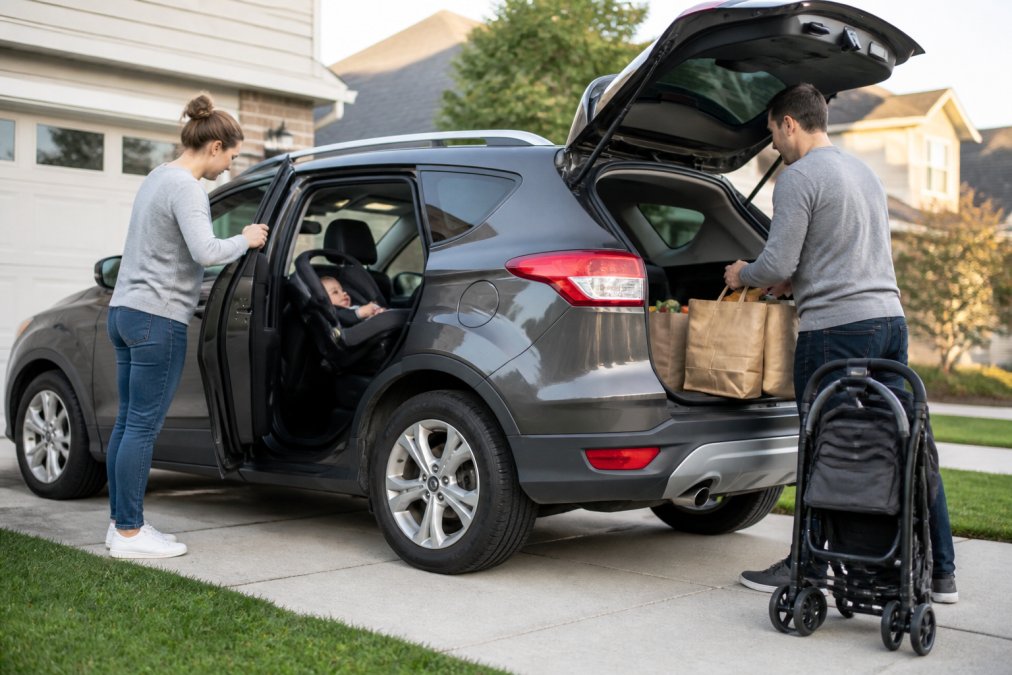
SUVs dominate family shopping because the higher ride height makes buckling a rear-facing car seat easier on your back. Ground clearance and available all-wheel drive also help in wet or snowy conditions.
Compact SUVs Under $10k
Budget-friendly compact SUVs under $10k exist, but you'll be shopping older model years with higher mileage. Prioritize a clean service history and a pre-purchase inspection over cosmetics.
Midsize SUVs With Third-Row Options
Midsize SUVs with a third row solve the "grandparents visit twice a year" problem. The trade-off is fuel economy and a third row that suits kids, not adults, on long trips.
Best Used Sedans for Small Families
Family sedans win on fuel economy, insurance premiums, and resale value. They're cheaper to run, easier to park, and often safer per dollar than a comparable SUV.
Hybrid vs. Gas Longevity
Hybrid longevity is better than most buyers assume. Hybrid powertrains often outlast gas-only counterparts because the engine runs less and regenerative braking slows brake wear.
Used Car Inspection Checklist for Family Vehicles
A used car inspection checklist for family vehicles goes beyond the standard mechanical once-over, adding child-safety and cargo checks that generic checklists skip.
- Test-install your car seat with LATCH and the seat belt
- Confirm all LATCH anchors are present and undamaged
- Check for a full-size spare or a repair kit
- Fold the rear seats and confirm they lock flat
- Verify service history and look for gaps in maintenance
- Scan for prior accident damage with a vehicle history report
- Test the rear-view camera and blind-spot monitoring
- Check tire tread depth and matching brands
How to Finance a Used Car With Challenged Credit
Financing a used car with challenged credit is possible, but terms hinge on your down payment and the lender's risk tolerance. A larger down payment lowers the amount financed and improves approval odds.
A few practical steps help here:
- Know your credit score before you shop
- Save the largest down payment you can manage
- Get pre-qualified so there are no surprises at signing
- Ask for the full cost of financing, not just the monthly payment
Total Cost of Ownership: What Families Actually Pay
Total cost of ownership (TCO) is the full cost of a vehicle over time: purchase price, fuel, insurance, maintenance, repairs, and depreciation combined. It determines whether a car is truly affordable, and most used-car listings never show it.
The Five Buckets of Five-Year TCO
For a typical used family vehicle bought at three to five years old and driven 12,000 miles a year, the five-year cost splits roughly like this:
- Depreciation, usually the largest single line. A new car can lose 20% in year one and about 60% of value by year five. Buying at three years old means the steepest drop is already behind you, so your depreciation curve is flatter.
- Fuel, driven by combined MPG and your local gas price. A 30 MPG sedan versus a 22 MPG SUV at 12,000 miles a year is a meaningful annual gap that compounds over five years.
- Insurance, varies by model, safety features, repair costs, and your driving record. Sedans and smaller SUVs generally carry lower premiums than large SUVs and trucks.
- Maintenance and repairs, oil changes, tires, brakes, fluids, and the occasional big-ticket item. Older hybrids and turbocharged engines can add cost; simple naturally aspirated four-cylinders usually cost less to keep running.
- Taxes and fees, registration, property tax where applicable, and inspection fees. Easy to forget, real every year.
A Worked Example
Take two used vehicles at the same $18,000 purchase price:
- Vehicle A, midsize sedan, 32 MPG combined, strong resale. Over five years, depreciation is modest, fuel cost is low, insurance is average, and maintenance is predictable. Total five-year outlay lands in the low-to-mid range for the segment.
- Vehicle B, compact SUV, 24 MPG combined, average resale. Depreciation is steeper, fuel cost is higher, insurance is slightly higher, and AWD adds a drivetrain to maintain. Total five-year outlay runs noticeably higher.
Depreciation: The Silent Line Item
Depreciation is not a bill you pay, it is value you lose, showing up the day you sell or trade in. Certified pre-owned vehicles soften the hit because the steepest early depreciation has already happened, and they often carry a manufacturer-backed warranty that offsets repair risk.
Maintenance History Verification
A clean service history is the single best predictor of low future repair costs. When you review records, look for:
- Oil change intervals, consistent changes at or near the manufacturer's recommended interval, not long gaps.
- Transmission and coolant service, often skipped by owners trying to save money, and expensive to fix later.
- Timing belt or chain service, on interference engines, a missed interval can mean catastrophic engine damage.
- Recall completion, check the manufacturer's recall lookup by VIN.
- Accident and title history, a vehicle history report plus a pre-purchase inspection by an independent mechanic.
Hybrid vs. Gas: The Longevity Question
Families shopping for fuel savings often look at used hybrids. Hybrid batteries commonly last well past 100,000 miles, and regenerative braking extends brake life. The trade-off: battery replacement is a real cost near the end of its life, and hybrid-specific repairs can be pricier at independent shops.
How to Estimate TCO Before You Buy
- Pull the combined MPG from the window sticker or the manufacturer's spec sheet.
- Get an insurance quote on the specific VIN, not the model in general.
- Ask a mechanic for an inspection that includes a written estimate of near-term repairs.
- Check the vehicle history report for accidents, title brands, and service gaps.
- Compare at least three candidates on the same five-year basis before deciding.
Fuel economy data by model and year
Conclusion
Choosing the best used cars for small families means weighing car seat fit, cargo space, and long-term costs together instead of chasing a single number. The right pick fits your kids, your budget, and your daily routine.
Frequently Asked Questions
What features should small families look for in a used car?
Prioritize safety ratings from the NHTSA and IIHS, rear-facing car seat fit, and cargo capacity for strollers or groceries. Look for a rear-view camera, blind-spot monitoring, and easy LATCH anchor access. Fuel economy and maintenance costs matter too, since family budgets stretch across years of ownership. A certified pre-owned vehicle with a clean service history reduces the risk of surprise repairs in the first year.
Are sedans or SUVs better for small families?
Sedans cost less to buy, insure, and fuel, and many midsize models fit two car seats with room to spare. SUVs offer easier car seat installation because of higher seat heights, plus more cargo space for strollers and gear. For one or two children, a family sedan often delivers better value. For three or more, or if you haul equipment regularly, a compact or midsize SUV usually works better.
How many miles is too many for a used family car?
There is no fixed cutoff, but 12,000 to 15,000 miles per year is typical. A five-year-old vehicle with 75,000 miles can still be a solid choice if the service history is complete. Focus on maintenance records, accident reports, and a pre-purchase inspection rather than mileage alone. Some well-maintained models run past 200,000 miles; neglected ones fail at 80,000.
How do I finance a used car with bad credit?
Start by checking your credit report for errors and saving what you can for a down payment. Many dealerships work with lenders who specialize in challenged credit, so ask about buy-here-pay-here or subprime financing options. Get pre-approved before you shop so you know your budget. Bring proof of income, residence, and insurance. A larger down payment and a shorter loan term reduce your interest rate.